Should you pay for social media reach or earn it organically? The honest answer is both, in a specific order: fix your free assets first (your profile, bio, and content), prove something works organically, then put paid budget behind the winners. Businesses that reverse that order, paying to promote an unoptimized presence, are renting traffic and sending it to a broken storefront.
That order matters more in 2026 than it ever has, because the free half of the equation keeps shrinking while the paid half keeps getting more expensive. This guide covers what each side actually delivers now, what it costs, and the one habit that quietly burns more small-business money than any other line item.
What counts as paid, and what counts as organic?
Organic is everything you publish without paying the platform to distribute it: posts, Reels, Stories, your bio, your comments and replies. Its reach depends entirely on the algorithm deciding your content deserves an audience.
Paid is any distribution you buy: campaigns built in Ads Manager, and the Boost button under your posts. Paid guarantees delivery to a defined audience at auction prices. It does not guarantee that anyone cares once they arrive.
The two are not competitors. They are different tools with different jobs, and most of the frustration people feel with social media marketing comes from asking one to do the other’s job.
What does organic reach actually look like in 2026?
Smaller than most business owners realize. Metricool’s analysis of hundreds of thousands of accounts found Facebook Page posts reaching an average of just 1.65% of followers in 2025, with a median engagement rate across industries of 0.15%. A page with 10,000 followers is typically putting each post in front of a few hundred people.
Instagram is tighter too. Socialinsider’s Q1 2026 benchmarks measured the average Instagram engagement rate at 0.48% across all account sizes, down roughly 24% year over year. The feed has shifted toward interest-based recommendations, which means your followers are no longer a guaranteed audience; they are just a starting signal.
None of this means organic is dead. It means organic reach is now earned per post rather than owed to you per follower. Content that genuinely holds attention still travels, and the profile that content points back to still does the converting, which is exactly why it has to be in order before you spend anything.
What does paid reach cost right now?
More than last year, and the direction of travel is consistent. Digital Applied’s 2026 benchmark report puts the average Facebook cost per click at $1.72 across industries, up 11% year over year. On the impression side, Triple Whale’s dataset covering nearly 35,000 brands recorded platform-wide CPMs rising about 20% through 2025.
Costs vary wildly by industry, so treat averages as a midpoint rather than a promise. The stable takeaway is this: every click you buy costs real money, which raises the value of every free improvement that makes those clicks convert better. A dollar spent on ads pointing at a sharp profile works harder than the same dollar pointing at a neglected one.
Paid vs organic at a glance
| Organic | Paid | |
|---|---|---|
| Cost | Time and consistency | Budget, rising yearly |
| Speed | Slow, compounds over months | Immediate |
| Targeting | Whoever the algorithm picks | Defined audiences |
| When it stops | Content keeps working | Reach ends with the budget |
| Best at | Trust, proof, community | Scale, speed, cold audiences |
| Worst at | Guaranteed delivery | Manufacturing credibility |
Why is the Boost button such an expensive habit?
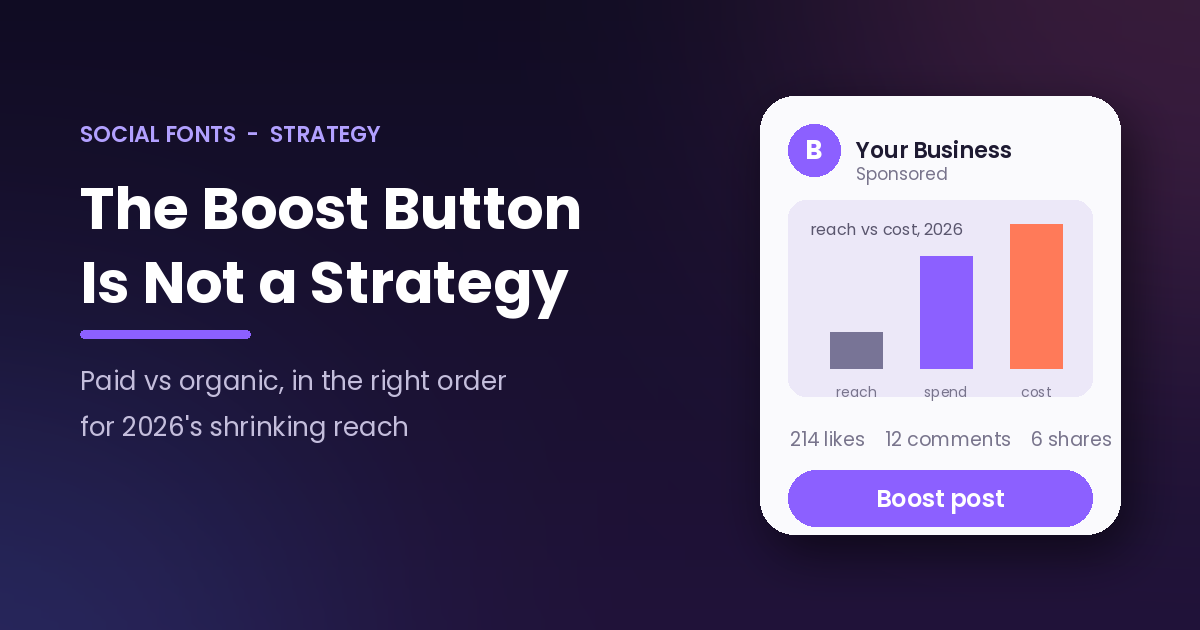
Because it feels like advertising while skipping everything that makes advertising work. Boosting optimizes for engagement by default, not for the business outcome you actually want, and it hands you almost none of the audience, placement, and objective controls that Ads Manager exists to provide. You pay campaign prices for a fraction of campaign capability.
I have spent fifteen years and more than $50 million of client budget inside ad platforms, and the pattern I see most often with new clients is the same: a history of boosted posts, a pile of likes from people who will never buy, and no idea what any of it returned. The money was not spent on marketing. It was spent on the feeling of marketing.
“Boosting a post to a broad audience is the most expensive way ever invented to feel productive. The platforms did not build that button for your benefit,” says Adam Palmer, President of Inertia Digital Marketing.
So what is the right order of operations?
First, fix what is free. Your bio and profile are where every interested person lands before they follow or buy, and they cost nothing to improve. Make the name field searchable, make one line say who you help, and use formatting deliberately; our guide to fancy fonts for social media bios covers how to do that in fifteen minutes with a free generator.
Second, prove something organically. Publish consistently for long enough to learn which messages and formats your audience responds to. Organic is your cheapest testing lab, because a post that dies organically will not be saved by budget.
Third, pay to amplify winners. When a post, offer, or message has already shown a pulse, put money behind it through Ads Manager with a real objective: leads, sales, or traffic, not engagement. Paid works best as a megaphone for something already worth hearing.
When does paid make sense from day one?
There are honest exceptions to the organic-first rule. Launches with a hard deadline, local businesses that need customers this month, and offers with proven demand elsewhere can all justify immediate spend, because waiting months for organic traction costs more than the ads do.
Even then, the sequence inside the exception holds: the profile gets fixed before the first dollar goes out, because you are about to pay for strangers to look at it.
What should you do Monday morning?
Pull up your last three months of spend and answer one question: what did it buy? If the honest answer is engagement on individual posts, pause the boosting entirely.
Then spend fifteen free minutes on the asset every ad and every post points back to, your profile, before you spend another paid dollar. If you cannot measure what a boost bought you, the budget was not working for you; it was working for the platform.
Frequently asked questions
Is organic social media dead in 2026?
No, but it has changed jobs. With average page reach in the low single digits, organic works less as a broadcast channel and more as a trust layer: the place people check you out before buying. It also remains the cheapest way to test messages before paying to scale them.
How much should a small business budget for social ads?
There is no universal number, and anyone quoting one is guessing. The sound approach is to start with a test budget you can afford to lose, measure cost per result against what a customer is worth to you, and scale only what proves itself.
Is boosting a post ever worth it?
Occasionally, for narrow jobs: putting an announcement in front of your existing warm audience, for example. As a growth strategy aimed at strangers, Ads Manager gives you far more control for the same money.
Do paid ads help organic reach?
Not directly; the platforms do not reward ad spend with better organic distribution. Indirectly, ads can grow an engaged audience whose interactions then help future organic posts perform.
Which matters more for a brand-new account?
The free foundation. A new account with a sharp profile and ten genuinely useful posts is ready to benefit from either strategy. A new account with neither will waste whatever it spends.
Adam Palmer is President of Inertia Digital Marketing, a digital marketing agency working with clients from small business to multi-location enterprise and franchise operations. Across 15 years he has managed more than $50 million in paid digital campaigns, and he writes here about what actually moves numbers rather than what sounds good in a strategy deck. Inertia built and maintains Social Fonts, which is free and always will be. Find him on LinkedIn.